HiSiliconhi3559A AI Development Board(Core Board+Base Board)
Project: Board Introduction | page_id: 882
| HI3559AV100 Board | |
|---|---|
| Model | XSWTVR-16CT59AV100/TX |
| CPU | HI3559AV100 |
| Video Encoding/Decoding | Supports H.264/H265 encoding/decoding, simultaneous encode/decode max resolution 38400x2160@30fps x4 |
| Storage | EMMC 32GB |
| Memory | 4GB |
| USB | USB 3.0 x1 |
| AI Computing Power | 4TOPS |
| Video Output | HDMI, max 4K@60 |
| Storage Interface | 1 SATA, supports up to 16TB HDD |
| Network | RJ45 10/100/1000M x2 |
| Operating Temperature | 0 to 70℃ |
| Service Life | Continuous operation lifespan of more than 2 years |
1. Product Images
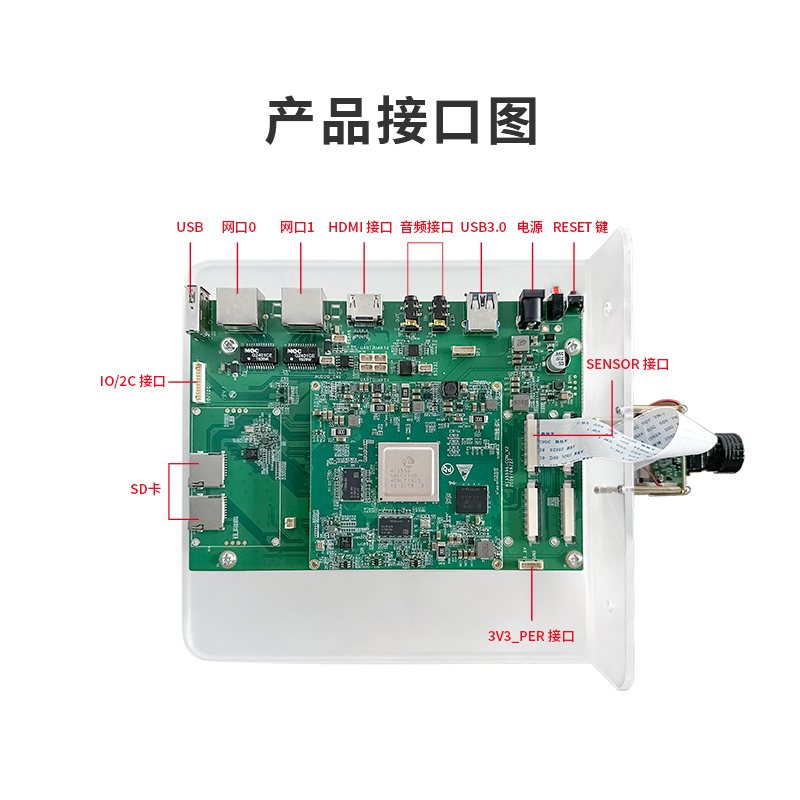
2. Chip Specifications
~ Dual-core ARM CortexA73@1.6GHz, 32KB I-cache, 64KB D-Cache / 512KB L2 cache
~ Dual-core ARM CortexA53@1.2GHz, 32KB I-cache, 32KB D-Cache / 256KB L2 cache
~ Single-core ARM CortexA53@1.2GHz, 32KB cache, 32KB D-Cache / 128KB L2 cache
~ Supports Neon acceleration, integrated FPU processing unit
-
GPU
~ Dual-core ARM MaliG71@900MHz, 256KB cache
~ Supports 0penCL 1.1/1.2/2.0
~ Supports 0penGL ES 3.0/3.1/3.2 -
Sensor Hub
~ Integrated ARM CortexM7@192MHz
~ Integrated PMC power control unit; PMC only supports external reset
~ Supports internal POR
~ Supports general peripheral IP (UART/SPI/I2C/PWM/GPIO/LSADC)
~ Supports 2-channel LSADC, 7 UART interfaces, 8 PWM interfaces -
Video Encoding
~ H.264 BP/MP/HP
~ H.265 Main Profile/Main10 Profile
~ H.264/H.265 supports I/P/B frame encoding mode
~ Supports MJPEG/JPEG Baseline
~ H.264 encoding supports a maximum resolution of 8192x8640 Pixel
~ H.265 encoding supports a maximum resolution of 16384x8640 Pixel
~ H.264/H.265 multi-stream real-time encoding capability:
~ 7680x4320@30fps + 1080P@30fps + 7680x4320@2fps snapshot
~ Supports maximum JPEG snapshot performance of 7680 x 4320@15fps
~ Supports five rate control modes: CBR/VBR/AVBR/FIXQP/QPMAP
~ Maximum output bitrate up to 200 Mbps
~ Supports 8 regions of interest (ROI) encoding -
Video Decoding
~ Supports H.264 BP/MP/HP
~ Supports H.265 Main Profile/Main10 Profile
~ Supports MJPEG/JPEG Baseline
~ Supports up to H.264/H.265 7680x4320@30fps or H.264/H.265 3840x2160@120fps
~ Supports up to 7680x4320@15fps JPEG decoding -
Intelligent Video Processing
~ Provides visual computing processing capability
~ Quad-core DSP@700MHz, 32K-Cache / 32K IRAM / 512KB DRAM
~ Dual-core NNIE@840MHz neural network acceleration engine
~ Built-in binocular depth detection unit -
Video and Image Processing
~ Supports anti-flicker processing for video and graphics output
~ Supports video 1/15.5~16x scaling
~ Supports up to 6-channel video 360°/720° panoramic stitching
~ Supports graphics 1/15.5~16x scaling
~ 8-region pre-encoding OSD overlay
~ 2-layer (video layer, graphics layer) video/graphics overlay -
ISP
~ Supports two independent ISP pipelines; the ISP supports time-division processing of multi-channel sensor input video
~ Supports 3A (AE/AWB/AF); 3A control is user adjustable
~ Supports fixed pattern noise (FPN) removal
~ Supports highlight suppression, backlight compensation, Gamma and color enhancement
~ Supports defective pixel correction, denoise and 6-Dof digital image stabilization
~ Supports 3D denoise, image enhancement and dynamic contrast enhancement
~ Supports defog
~ Supports lens distortion correction and fisheye correction
~ Supports image 90°/270° rotation
~ Supports image mirror and flip
~ Supports HDR10
~ Supports BT.2020 wide color gamut
~ Supports Sensor Built-in WDR, 4F/3F/2F-Frame base/Line base WDR and Local Tone Mapping
~ Provides PC-side ISP tuning tools -
Audio Encoding/Decoding
~ Multi-protocol voice codec implemented in software
~ Supports G.711/G.726/AAC and other audio encoding formats
~ Supports audio 3A (AEC/ANR/ALC) processing -
Security Engine
~ Hardware implementation of AES/DES/3DES encryption/decryption algorithms
~ Hardware implementation of RSA1024/2048/3072/4096 signature verification algorithms
~ Hardware implementation of HASH anti-tampering algorithms, supporting HASH SHA1/224/256/384/512 and HMAC_SHA1/224/256/384/512 algorithms
~ Internally integrates 32KBit OTP storage space and a hardware random number generator -
Video Interfaces
Video Interfaces
~ Input
~ Supports 8-channel sensor input
~ Max resolution up to 32M (7680x4320) or 36M (6000x6000)
~ Supports 8/10/12/14 bit RGB Bayer DC timing video input, max clock frequency 150MHz
~ Supports BT.601, BT.656, BT.1120 video input interfaces
~ Sensor serial input supports up to 16xLane MIPI/LVDS/Sub-LVDS/HiSPi/SLVS-EC interfaces
~ Sensor serial input supports up to 8 video inputs, supporting 1x16Lane / 2x8Lane / 4x4Lane / 2x4Lane+4x2Lane / 8x2Lane and other working modes
~ Compatible with various sensor parallel/differential interface electrical characteristics
~ Provides programmable sensor clock output
~ Output
~ Supports HDMI2.0, up to 4K@60fps output
~ Supports 6/8/16/24bit RGB digital LCD output, up to 1920x1080@60fps output
~ Supports 4xLane MIPI DSI output, max frequency up to 2.5Gbps/Lane -
Audio Interface
~ Integrated audio codec, supporting 16bit voice input and output
~ Supports I2S interface, supports connecting an external audio codec
~ Supports dual-channel Mic differential input to reduce the noise floor -
SDK
~ Supports Linux SMP
~ Supports Linux + Huawei LiteOS dual-system AMP
~ Provides a high-performance H.265 decoding library -
Chip Physical Specifications
~ Power consumption
~ 3W typical power consumption (4K120)
~ Supports multi-level power saving modes
~ Operating voltage
~ Core voltage 0.8V
~ IO voltage 1.8V
~ DDR4 SDRAM interface voltage 1.2V
~ LPDDR4 interface voltage 1.1V
~ Package
~ RoHS, TFBGA
~ Pin pitch: 0.65mm
~ 25mm x 25mm package size
Note: the core board does not include peripheral interfaces such as power, serial port and communication interfaces. If you purchase the core board alone, only the core board interface circuit diagram is provided.
If you need peripheral interfaces, please purchase the core board + base board kit.
3. FAQ
| Question | Answer |
|---|---|
| 1. Can the core board run programs directly? | Yes, it can run directly |
| 2. Without a base board, can the board be powered and connected to a camera or monitor? | No |
| 3. What does the complete product include? Is there a sensor lens board? | It includes the core board, base board, debug cable and development virtual machine; there is an imx334 sensor board |
| 4. What materials can be provided with this board? | A complete SDK is provided |
| 5. Are connectors and debuggers included when buying your development board? | Yes, debugging is done directly through the serial port |
| 6. Can HDMI 2.0 be upgraded to HDMI 2.1? | No, the hardware does not support it |
| 7. What is the system boot medium? | eMMC |
| 8. Is PCIe brought out? | Yes, it is |
| 9. How many PCIe lanes? | PCIe x1 |
| 10. Does it support CAN, serial port, Ethernet and MIPI camera? | Serial port, Ethernet and MIPI camera are supported; CAN is not supported |
| 11. Can it connect 8 cameras? | No, only 4. The core board can theoretically support 8 channels, but our base board only supports 4 channels |
| 12. Can 4 cameras be stitched? Do you provide technical support for 4-channel stitching? | 4-channel stitching is possible, but no technical support is provided. The development board requires your own development capability |