HiSiliconHi3403V100Development Board
Project: Board Introduction | page_id: 1015
1. Product Images
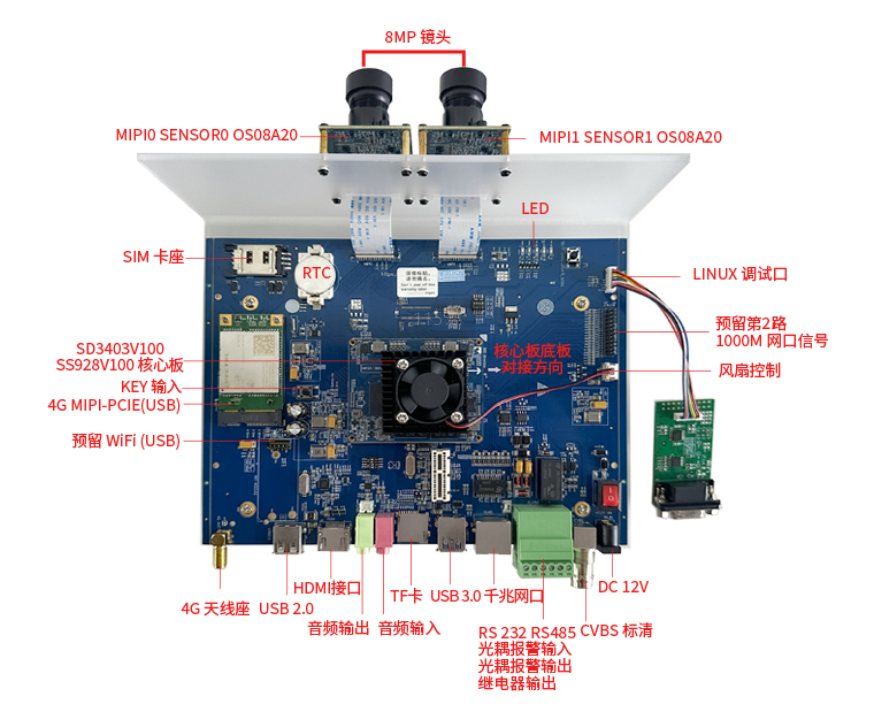
2. Chip Overview
Yueying Hi3403V100, also known as SS928V100, SD3403V100, or 21AP10, is a professional ultra HD intelligent network video recorder SoC launched for the market.
1. The chip supports up to four sensor inputs, supports ISP image processing capability of up to 4K60, and supports 3F WDR, multi-level noise reduction, six-axis image stabilization, hardware stitching and other image enhancement and processing algorithms, providing users with excellent image processing capability.
2. It integrates a quad-core A55, providing efficient, rich and flexible CPU resources to meet customer computing and control requirements. A single-core MCU is integrated to meet scenarios with high requirements for low latency.
3. It integrates an efficient image analysis tool inference unit, up to 4ToPS INT8, and supports the mainstream image analysis tool frameworks in the industry as well as common deep learning architectures (Caffe, TensorFlow, ONNX, etc.). A dual-core Vision DSP is also built in to meet some of the differentiated CV computing requirements of customers.
4. It adopts an advanced 12nm low-power process and 0.65 pitch package, and supports LPDDR4/LRDDR4x/DDR4 particles, meeting the requirements of product miniaturization design and fast mass production. A stable and easy-to-use SDK design is provided to support customers in fast product mass production.
3. Main Chip Features
Processor Core
★Quad-core ARM Cortex A55@1.4GHz
-32KB-Cache,32KB D-Cache /512KB L3 cache
Supports Neon acceleration, integrated FPU processing unit
★Built-in 32bit MCU@500MHz
-32KB-Cache,32KB D-Cache /64KB TCM
Intelligent Video Analysis
★Image analysis tool acceleration engine, with a theoretical computing capability of up to (4.8T+5.6T=10.4Tops@INT8)!
The NNN (dite core x1) supports 4.8Tops@INT8, and also supports INT4/FP16
In addition, SVP_NNN (dpico core x1) supports 5.6Tops@INT8
Supports complete APIs and tool chains, easy for customer development
★Dual-core Vision Q6 DSP (the tool software is not licensed, so customers cannot use it; genuine DSP software development tools are quite expensive!)
32K-Cache /32K D-Cache/32K IRAM/320K DRAM
★Built-in intelligent computing acceleration engine (IVE, etc.)
★Built-in binocular depth acceleration unit
★Built-in matrix computing acceleration unit
Video Codec
★H.264 BP/MP/HP
★H.265 Main Profile
★H.264/H.265 codec maximum resolution 8192x8192
★H.264/H.265 encoding supports I/P frames
★H.264/H.265 multi-stream encoding capability:
3840x2160@60fps+1280x720@30fps
-7680x4320@15fps
★H.264/H.265/MPEG-4 multi-stream decoding capability:
-3840x2160@60fps+1920x1080@60fps
★Supports pre-encoding OSD overlay for up to 8 regions
★Supports CBR/VBR/AVBR/FIXQP/QPMAP and other bitrate control modes
★Maximum output bitrate 100Mbps
★Supports encoding of 8 regions of interest (ROI)
★Supports JPEG Baseline codec
★JPEG codec maximum resolution 16384x16384
★Maximum JPEG performance
Encoding: 3840x2160@60fps (YUV420)
Decoding: 3840x2160@75fps (YUV420)
Video Input Interface
★Supports 8-Lane image sensor serial input, supports multiple interfaces such as MIPI/LVDS/Sub-LVDS/HiSPi
★Supports various combinations such as 2x4-Lane or 4x2-Lane, supports up to 4 channels of sensor serial input
★Maximum resolution 8192x8192
★Supports 8/10/12/14Bit RGB Bayer DC timing video input, clock frequency up to 150MHz
★Supports BT.601, BT.656, BT.1120 video input interfaces
★Supports mainstream CMOS level thermal imaging sensors
Digital Image Processing (ISP)
★ISP supports time-division multiplexing processing of multiple sensor input videos
★Supports 3A (AE/AWB/AF) functions, and the 3A control is adjustable by the user
★Supports fixed pattern noise removal (FPN)
★Supports defective pixel correction and lens shading correction
★Supports up to three-frame WDR and Advanced Local Tone Mapping
★Supports multi-level 3D denoising, image edge enhancement, defog, dynamic contrast enhancement and other processing functions
★Supports 3D-LUT color adjustment
★Supports lens distortion correction and fisheye correction
★Supports 6-DoF digital image stabilization and Rolling-Shutter correction
★Supports image Mirror, Flip, 90 degree/270 degree rotation
★Provides PC-side ISP tuning tools
Video and Graphics Processing
★Supports graphics and image 1/15.5~ 16x scaling
★Supports up to 4 channels of video panoramic stitching
Input 2 channels of 3840x2160, output 4320x3840, i.e. it can capture 2 channels of 4K@30fps at the same time!
-Input 4 channels of 2688x1520, output 6080x2688, i.e. it can capture 4 channels of 4M@30fps at the same time!
★Supports video layer and graphics layer overlay
★Supports color space conversion
Video Output
★Supports HDMI2.0 interface output
★Supports 4-Lane MIPI DSI/CSI interface output, up to 2.5Gbps/lane
★Built-in analog standard definition CVBS output
★Supports 8/16/24 bit RGB, BT.656, BT.1120 and other digital interfaces
★Supports 2 independent HD video outputs at the same time
Supports non-same-source output of any two interfaces
One of them can support PIP (Picture In Picture)
★Maximum output capability 3840x2160@60fps + 1920x1080@60fps
Audio Interface and Processing
★Built-in Audio codec, supports 16bit voice input and output
★Supports I2S interface
-Supports multi-channel time-division multiplexing transmission mode (TDM)
★Supports HDMI Audio output
★Multi-protocol voice codec implemented by software
★Supports audio 3A (AEC/ANR/ALC) processing
★Supports G.711/G.726/AAC/ and other audio encoding formats
Security Isolation and Engine
★Supports secure boot
★Supports REE/TEE hardware isolation solution based on TrustZone
★Hardware implementation of the AES symmetric encryption algorithm
★Hardware implementation of the RSA2048/3072/4096 signature verification algorithm
★Hardware implementation of HASH-based SHA/256/384/512 and HMAC SHA256/384/512 algorithms
★Hardware implementation of random number generator
★Integrated 30Kbit OTP storage space for customer use
Network Interface
★2 Gigabit Ethernet interfaces
Supports RGMII and RMII interface modes
Supports TSO, UFO, COE and other acceleration units
Supports Jumbo Frame
Peripheral Interfaces
★Supports power-on reset (POR) and external input reset
★Integrated 4-channel LSADC
★Multiple UART, I2C, SPI, GPIO interfaces
★2 SDIO3.0 interfaces
-SDIO0 supports SDXC cards, maximum capacity 2TB
-SDIO1 supports connecting a WiFi module
★2 USB3.0/USB2.0 interfaces
-USB0 supports Host only
-USB1 can be switched between Host and Device
★2-Lane PCIe2.0 high-speed interface
Supports RC/EP mode
Can be configured as 2-Lane PCIe2.0
Can be configured as 1-Lane PCIe2.0 + USB3.0
External Memory Interface
★DDR4/LPDDR4/LPDDR4x interface
Supports 4 x16bit DDR4
Supports 2x32bit LPDDR4/LPDDR4x
DDR4 maximum rate 3200Mbps
LPDDR4/LPDDR4x maximum rate 3733Mbps
Maximum capacity 8GB
★SPI Nor/SPI Nand Flash interface
Supports 1, 2, 4-wire modes
SPI Nor Flash supports 3Byte and 4Byte address modes
★NAND Flash interface
Supports SLC and MLC asynchronous interface devices
Supports 2/4/8/16KB page size
Supports 8/16/24/28/40/64bit ECC (in units of 1KB)
★eMMC5.1 interface, maximum capacity 2TB
★Can choose to boot from eMMC, SPI Nor/SPI Nand Flash, NAND Flash or PCIe slave chip
SDK
★Arm CPU supports Linux SMP
★DSP/MCU supports LiteOS
Chip Physical Specifications
★Power Consumption
-Typical power consumption (4K@60fps + 4Tops): about 6.3W; maximum 110° junction temperature scenario: up to 7.1W, which is relatively high.
Power consumption control: in some scenarios where the DSP and MCU cores are not used, the power consumption can be further reduced. With good chip heat dissipation to keep the chip from working at the maximum junction temperature, the minimum system power consumption can be controlled within 6W
★Operating Voltage
Core voltage 0.8V
IO voltage 1.8/3.3V
DDR4/LPDDR4/LPDDR4x interface voltages are 1.2/1.1/0.6V respectively
★Package Form
RoHS, FC-BGA 23mmx23mm package
Pin pitch: 0.65mm
4. Application Fields
- High-end video surveillance
- High-end video analysis products
- High-end intelligent traffic cameras
- High-end industrial cameras
- High-end low-light cameras
- Industrial drones
- Edge servers
- High-end action cameras
- Dual-screen independent display products
5. Core Board Introduction
No. Resource Description
1. Main chip SS928V100 (SD3403V100)
2. Memory LPDDR4X 8G BYTES (3733MHz - 2 chips combined into a 64BIT bus!)
3. EMMC FLASH 32G BYTES (8G BYTES optional)
4. Ethernet port PHY 10M/100M/1000M adaptive dual-port PHY
5. Integrates the core board power supply voltage and timing, simplifies the baseboard power supply, and facilitates customer baseboard design
6. Reset system, supports watchdog hardware reset
7. Reserved hardware encryption chip, convenient for customers with software encryption requirements
8. Reserved SPI NAND FLASH; reserved functions require customization
9. Dimensions 65mm 52mm 10mm (without heat sink)
10. Distance between core board and baseboard 5mm
11. Operating temperature -30°-----60° recommended (with a large heat sink; higher temperatures require a fan)
12. Power consumption: typical scenario: <6W, maximum scenario: <7.5W
13. Imported high-end BTB connector to ensure a tight and stable connection between the core board and the baseboard
14. BTB signal definition
J1 connector J1 connector signals
15. 4-LANE MIPI DSI/CSI output Supported, used for video output, the signals are independent and separate from the HDMI below
16. 2nd SPI2 interface Supported
17. Standard definition analog CVBS Supported, can be directly connected to old TV sets and standard definition monitors
18. 1 left/right channel audio output Supported
19. 1 left/right channel audio input Supported
20. UART1 interface Supported, multiplexed with the control signals of the 2nd Ethernet port
21. 4 P-IRIS-CONTROL signals Supported, can also be used as GPIO
22. 1 SD card (TF card) Supported, uses the SDIO0 port
23. 1st Ethernet port Supported, directly connected to the network transformer
24. 2nd Ethernet port PHY signals Supported, needs to be connected to the Ethernet PHY chip, multiplexed with the SDIO1 port, and can also be connected to a WiFi module
25. 1 USB2.0 Supported, Host mode only
26. 1 USB3.0 Supported, both Host and Device modes
27. 1 PCIe2.0 Supported
28. 1 TF card burning mode selection Supported, i.e. UPDATE-MODE-N, multiplexed with GPIO0-0
No. Resource Description
J2 connector J2 connector signals
29. DC 3.3V Supports the baseboard supplying 3.3V power to the core board
30. DC 5V Supports the baseboard supplying 5V power to the core board
31. HDMI video output Supported, independent HDMI2.0 video output interface
32. JTAG signals Supported, can be multiplexed as GPIO
33. UART5 interface Supported
34. UART4 interface Supported
35. IR-CUT control interface Supported, can be multiplexed as GPIO
36. UART0 Supported, used for software LINUX development and debugging
37. I2C0 Supported
38. I2C2 Supported, used together with the MIPI0 interface
39. I2C3 Supported; I2C2 and I2C3 can also be multiplexed as the SPI0 interface
40. MIPI0 video input Supported, 4-LANE mode, and can also be split into two 2-LANE modes
41. MIPI1 video input Supported, 4-LANE mode; MIPI1 and SPI1 interfaces can also be configured as BT1120 input or BT656 input, or connected to a thermal imaging SENSOR
42. I2C4 Supported, used together with the MIPI1 interface
43. I2C5 Supported; I2C4 and I2C5 can also be multiplexed as the SPI1 interface
44. Independent GPIO Supported, few in number because they are multiplexed with other interfaces
45. PWM Supported, multiplexed with other GPIO signals
6. Baseboard Introduction
- Uses two imported high-end 0.8mm pitch 100PIN BTB connectors to dock with the core board;
- DC 12V-2A power input;
- Supports 1 10M/100M/1000M Ethernet port:
- Supports a reserved connector for the 2nd Ethernet port signals;
- Supports 2 channels of MIPI 4-LANE video input, which can support up to 2 channels of 8MP@30fps simultaneous capture, or up to 4 channels of 4MP@30fps simultaneous capture, or 1 channel of 4K (3840X2160@30fps) + 1080P combined simultaneous capture;
- The 2nd MIPI1 port and SPI1 port can be multiplexed and configured as BT1120/BT656 digital video input;
- Supports RTC circuit;
- Supports 1 audio input;
- Supports 1 audio output;
- Supports 1 amplifier audio output, for connecting a speaker;
- Supports 1 optocoupler input circuit;
- Supports 1 optocoupler output circuit;
- Supports 1 relay output circuit;
- Supports 1 TF card circuit;
- Supports 1 RS232 circuit;
- Supports 1 RS485 circuit;
- Supports 1 USB2.0 HOST, which can be expanded to 4 USB2.0 HOST through a USB HUB:
- Supports 4G circuit, the software supports the Quectel EC20 4G module by default;
- Supports 1 USB3.0 HOST interface;
- Supports 1 HDMI-V2.0 output;
- Supports 1 CVBS output (standard definition analog output for connecting to old TV sets);
- Supports multiple I2C interfaces;
- Supports 1 SPI interface;
- Supports 1 fan control circuit;
- Supports other PWM and GPIO circuits;
- Supports 1 LINUX development and debugging interface (a serial port board is included for connecting to UART0);
- Supports 1 PCIe2.0 interface (reserved circuit, not tested);
- Supports 1 WIFI interface (uses USB signals);
7. SENSOR Board Introduction
Equipped with the OS08A20 featuring breakthrough Nyxel near-infrared (NIR) technology. While maintaining a high modulation transfer function conversion, Nyxel technology shows a significant quantum efficiency (QE) improvement in the 850nm and 940nm bands, enabling the OS08A20 to monitor a larger area than conventional technology. No external illumination source is needed, which not only reduces power consumption but also improves security for covert surveillance. The OS08A20 is also a color CMOS image sensor that adopts a back-illuminated PureCel pixel structure, capable of capturing clear and detailed color images during the day. The OS08A20 supports image sizes up to 3840x2160 (16:9 aspect ratio) and can shoot high-resolution video at 60 frames per second. To improve sensor sensitivity, it uses a 2x2 micron pixel size and a 1/2 inch optical format.
★★★Disclaimer: The software of the two OV OS08A20 lens boards currently shipped with the development board uses the official default ISP parameters and drivers, with WDR (HDR) not enabled, so the actual effect may need optimization. If HDR is enabled, the overall scene will be warmer and black objects will appear slightly red. Please understand.
8. FAQ
| Question | Answer |
|---|---|
| 1、How many pixels is the camera equipped with? Is there an IRCUT? | 8 megapixels, without IRCUT |
| 2、 Does it support a container/docker runtime environment? | Docker is not supported |
| 3、Do you provide a full SDK so that I can modify and compile the kernel myself to support docker? | A full SDK is provided, and the kernel is provided |
| 4、Is there an AI SDK interface software performance evaluation included? | Yes, it is available |
| 5、Is the system a Server version or one with a graphical interface? | Pure Linux, without a graphical interface, backend only |
| 6、What is the relationship between SS928, SS927 and hi3403? I don't understand. | You can refer to this diagram: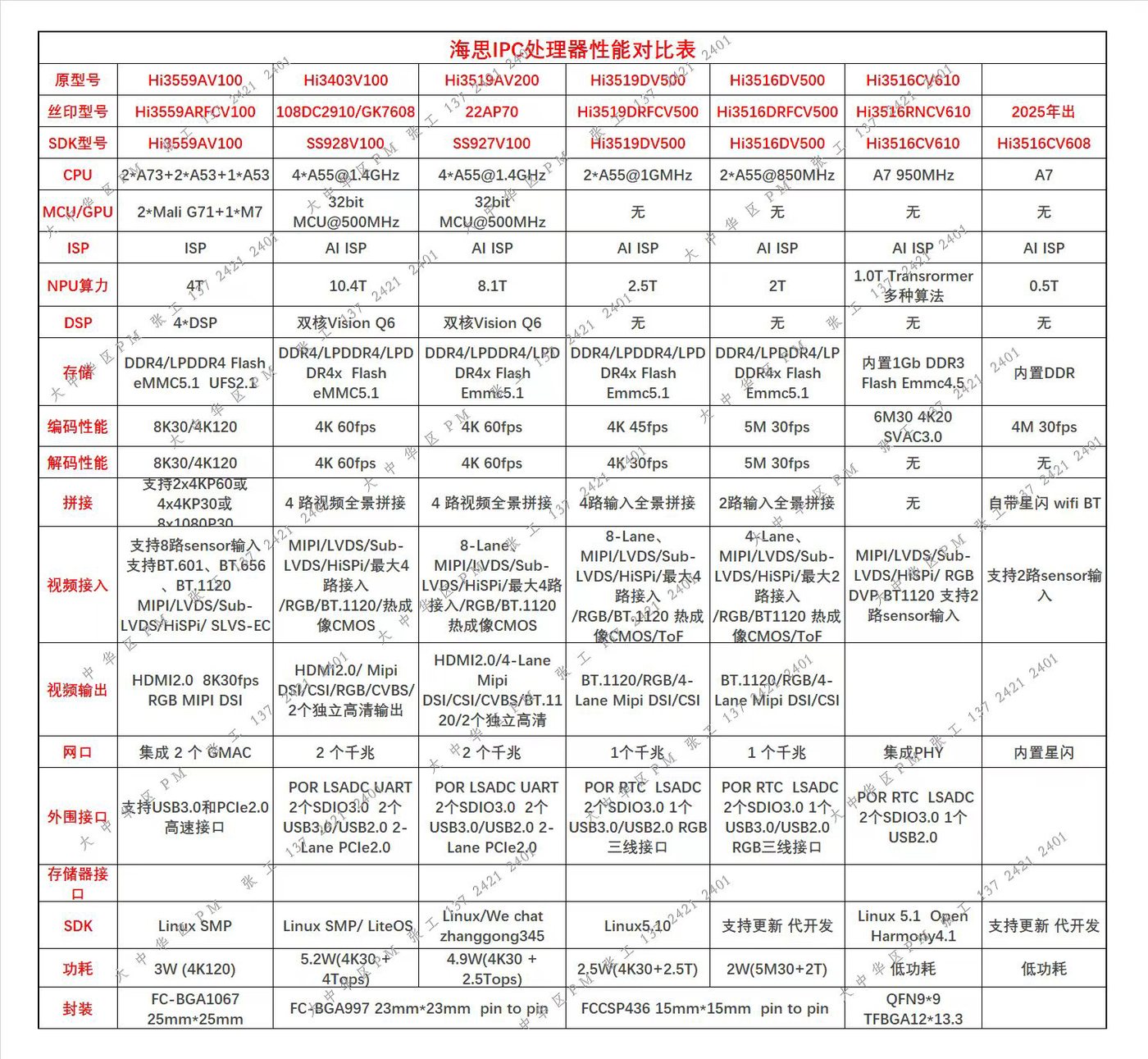 |
| 7、Why do the materials only include the core board of ss927 and not ss928? ? | Because the two are pin2pin compatible, which means the ss927 core board and the ss928 core board are the same.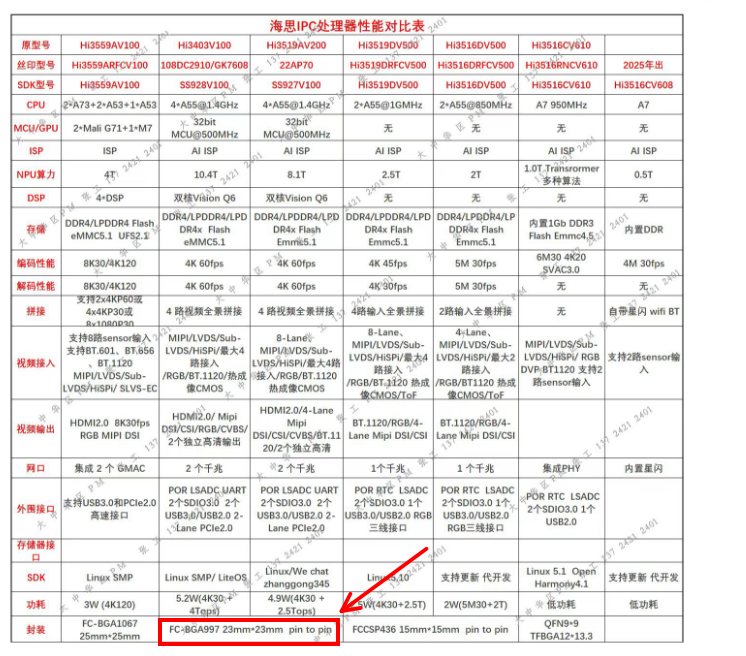 |
| 8、Only part of the core board schematic is provided. Can't you provide all of it? | We do not provide it. No hardware materials are provided for the core board, only the interface diagram. We do not provide hardware materials for any of our core boards |