HiSiliconhi3516ev300+imx335Development Board
Project: Board Introduction | page_id: 873
| 3516ev300+imx335 Module | |
|---|---|
| Model | XSWTVR-1CE16V300335/EX |
| CPU | HI3516EV300 |
| Video Encoding | Supports H.265/H.264 encoding/decoding, maximum resolution 2592x1944@15fps |
| Audio Input | Sampling rate: 8K/12K/16K/24K/32K/44.1K/48K |
| Audio Output | Supported |
| Storage | SPI nor 128Mbit flash |
| USB | USB 2.0 |
| Network | RJ45 10/100M |
| Operating Temperature | 0 to 70℃ |
| Service Life | Continuous operation life of more than 2 years |
I. Product Images
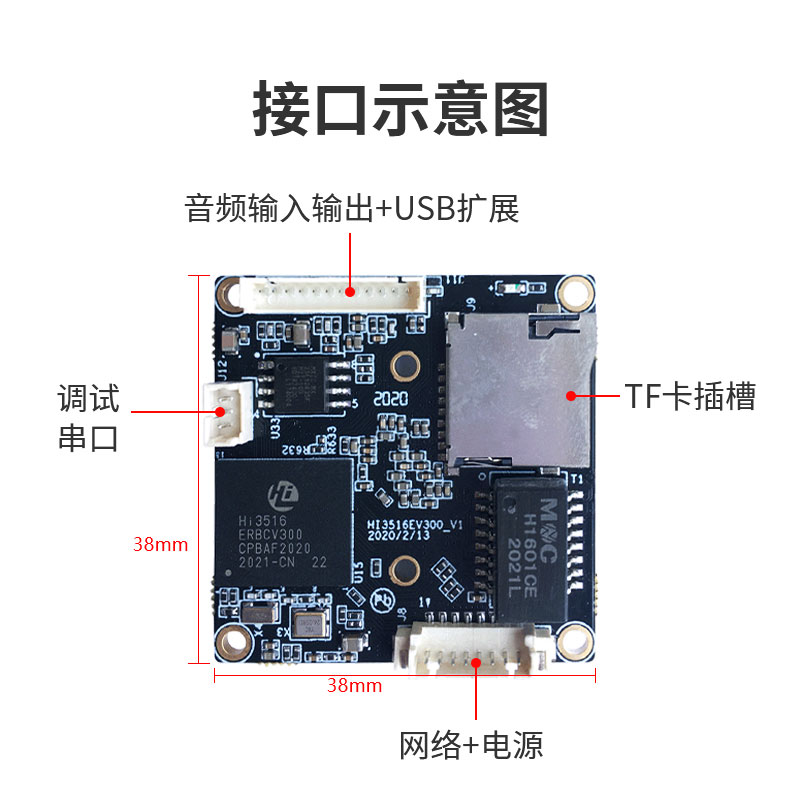
II. Chip Parameters
Processor Core
* ARM Cortex A7@ 900MHz,32KB I-Cache,32KB DCache/128KB L2 cache
Video Encoding
* H.264 BP/MP/HP,supports I/P frames
* H.265 Main Profile,supports I/P frames
* MJPEG/JPEG Baseline encoding
Video Encoding Processing Performance
* H.264/H.265 encoding supports a maximum resolution of 2688x1520/2592x1944, with a maximum width of 2688
* H.264/H.265 multi-stream real-time encoding capability:
− 2048x1536@30fps+720x576@30fps
− 2304x1296@30fps+720x576@30fps
− 2688x1520@15fps+720x576@15fps
− 2592x1944@15fps+720x576@15fps
* Supports JPEG capture 4M(2688x1520)@5fps/5M(2592x1944)@5fps
* Supports six bitrate control modes: CBR/VBR/FIXQP/AVBR/QPMAP/CVBR
* Supports smart encoding mode
* Output bitrate up to 60Mbps
* Supports encoding of 8 regions of interest (ROI)
Intelligent Video Analytics
* Integrated IVE intelligent analysis acceleration engine
* Supports intelligent motion detection, perimeter protection, video diagnosis and other intelligent analysis applications.
ISP
* Supports 4x4 Pattern RGB-IR sensor
* 3A(AE/AWB/AF),supports third-party 3A algorithms
* Fixed pattern noise removal, bad pixel correction
* Lens shading correction, lens distortion correction, purple fringing correction
* Direction-adaptive demosaic
* gamma correction, dynamic contrast enhancement, color management and enhancement
* Region-adaptive defog
* Multi-level noise reduction (BayerNR, 3DNR) and sharpening enhancement
* Local Tone mapping
* Sensor Built-in WDR
* 2F-WDR frame mode
* Digital image stabilization
* Supports intelligent ISP adjustment, provides PC-side ISP tuning tools
Audio Codec
* Multi-protocol voice codec implemented by software
* Protocols supported: G.711、G.726、ADPCM
* Supports audio 3A(AEC、ANR、AGC)functions
Security Engine
* Hardware implementation of AES/RSA encryption and decryption algorithms
* Hardware implementation of HASH(SHA1/SHA256/HMAC_SHA1/HMAC_SHA256)
* Internally integrated 32Kbit one-time programmable space and random number generator
Video Interface
* Input
− Supports 8/10/12bit RGB Bayer DC timing video input, supports BT.1120 input
− Supports MIPI, LVDS/Sub-LVDS, HiSPi interfaces
− Supports connection with mainstream HD CMOS sensors from SONY, OmniVision, Panasonic, etc.
− Compatible with various sensor parallel/differential interface electrical characteristics
− Provides programmable sensor clock output
− Supports a maximum input resolution of 2688x1520/2592x1944
* Output
− Supports 6/8/16bit LCD output
− Supports BT656/BT1120 output
Audio Interface
* Integrated Audio codec, supports 16bit voice input and output
* Supports dual-channel mic/line in input
* Supports mono line out output
* Supports I2S interface, supports connection with an external Audio codec
Peripheral Interfaces
* Supports POR
* Integrated high-precision RTC
* Integrated 4-channel LSADC
* 3 UART interfaces
* Supports I2C, SPI, GPIO and other interfaces
* 4 PWM interfaces
* 2 SDIO2.0 interfaces
* 1 USB 2.0 HOST/Device interface
* Integrated FE PHY; supports TSO network acceleration
* Integrated PMC standby control unit
External Memory Interface
* SDRAM interface
− Built-in 1Gbit DDR3L
* SPI NOR Flash interface
− Supports 1, 2, 4-wire modes
− Maximum capacity supported 256MB
* SPI NAND Flash interface
− Supports 1, 2, 4-wire modes
− Maximum capacity supported 1GB
* Supports Emmc5.0 interface
− 4/8bit data width
SDK
* Provides SDK packages based on Huawei LiteOS/Linux-4.9
* Provides a high-performance H.264 PC decoding library
* Provides high-performance H.265 PC, Android, iOS decoding libraries
Chip Physical Specifications
* Power consumption
− 3M30/4M15 scenario, 1W typical power consumption
* Operating voltage
− Core voltage 0.9V
− IO voltage 3.3V(+/-10%)
− DDR3L SDRAM interface voltage 1.35V
* Package
− 12mm x 13.3mm,279pin 0.65mm pin pitch,TFBGA package
III. IMX335 Sensor Parameters
| 5MP Camera | ||
|---|---|---|
| Camera | Main Chip | HiSilicon Hi3516ev300 |
| Sensor Type | IMX335 1/2.8'' CMOS Image Sensor with Square Pixel for Color Cameras | |
| Lens | 2.8mm~6mm: F1.6 horizontal field of view 79°~51° | |
| Minimum Illumination | Color:0.001 Lux @(F1.2,AGC ON);B/W:0.0003Lux @(F1.2AGC ON),0 Lux with IR | |
| Lens Interface Type | M20 | |
| Shutter | 1 second to 1/100.000 second | |
| Day/Night Switching Mode | ICR infrared cut filter | |
| Video Processing | 3A(AE,AF,and AWB)function | |
| Compression Standard | Video Compression Standard | H.265/H.264/MJPEG |
| H.265 Encoding Type | Main Proflie | |
| H.264 Encoding Type | BaseLine Profile/Main Profile/High Profile | |
| Video Compression Bitrate | 32Kbps~8Mbps | |
| Image | Max Video Resolution | 2592x1944 |
| Main Stream Resolution and Frame Rate | 2591x1944@15fps,2688x1520@25fps,2304x1296@30fps,2048x1536@30fps | |
| Sub Stream Resolution and Frame Rate | 704x480@60hz 640x480@60hz | |
| Highlight Suppression | Supported | |
| Electronic Image Stabilization | Supported | |
| Defog | Supported | |
| Day/Night Switching Mode | Day, night, auto | |
| OSD | Supports PNG image overlay | |
| AI Function | Motion Detection | Through the 4x4 pixel motion detection function of the HiSilicon chip, combined with the intelligent analysis thrown-object algorithm, using the background modeling algorithm based on 4x4 pixels to determine whether the pixel has changed |
| High-Altitude Thrown Object Detection | By judging the moving direction of the object, it identifies high-altitude thrown object behavior and performs emergency video saving | |
| Alarm Function | Supports linkage with the platform to send alarm information | |
| Network Function | Interface Protocol | ONVIF |
| Security Protocol | Password protection | |
| Network Protocol | TCP/IP,HTTP,FTP,DHCP,DNS,RTP,RTSP,RTMP | |
| Remote Management | Supports remote management | |
| Storage Function | Supports standard Micro SD/Micro SDHC up to 128g local storage | |
| Interface | Communication Interface | 1 10M/100M adaptive RJ45 Ethernet port |
| Audio Interface | 1 pair of audio input and output (1 channel line in/out) | |
| 4G Module | Supported Wireless Bands | LTE-TDD :B34/B38/B39/B40/B41 |
| LTE-TDD :B1/B3/B5/B8 | ||
| TD-SCDMA :B34/B39 | ||
| CDMA: BC0 | ||
| GSM: 900/1800MHz | ||
| General Specifications | Power Supply | DC12V |
| Operating Temperature | -20℃~80℃ | |
| Operating Humidity | Humidity less than 95% (non-condensing) | |
| Protection Level | IP66 | |
| Dimensions(mm) | 38x38 |
IV. Core Board Physical Parameters
* Dimensions:3838mm
* Built-in 1Gbit DDR3L,with 1 external DDR3(L)
* 128Mb Nor Flash
* IMX335 sensor*
V. Core Board Reserved Interfaces
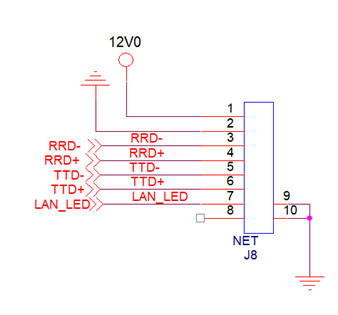
* 12V power supply + 100M network(8pin)1
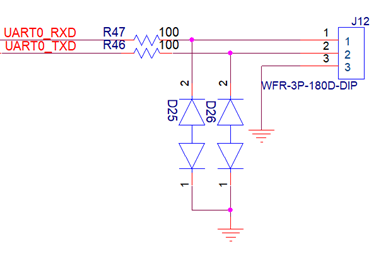
* Serial port debugging interface(3pin)1
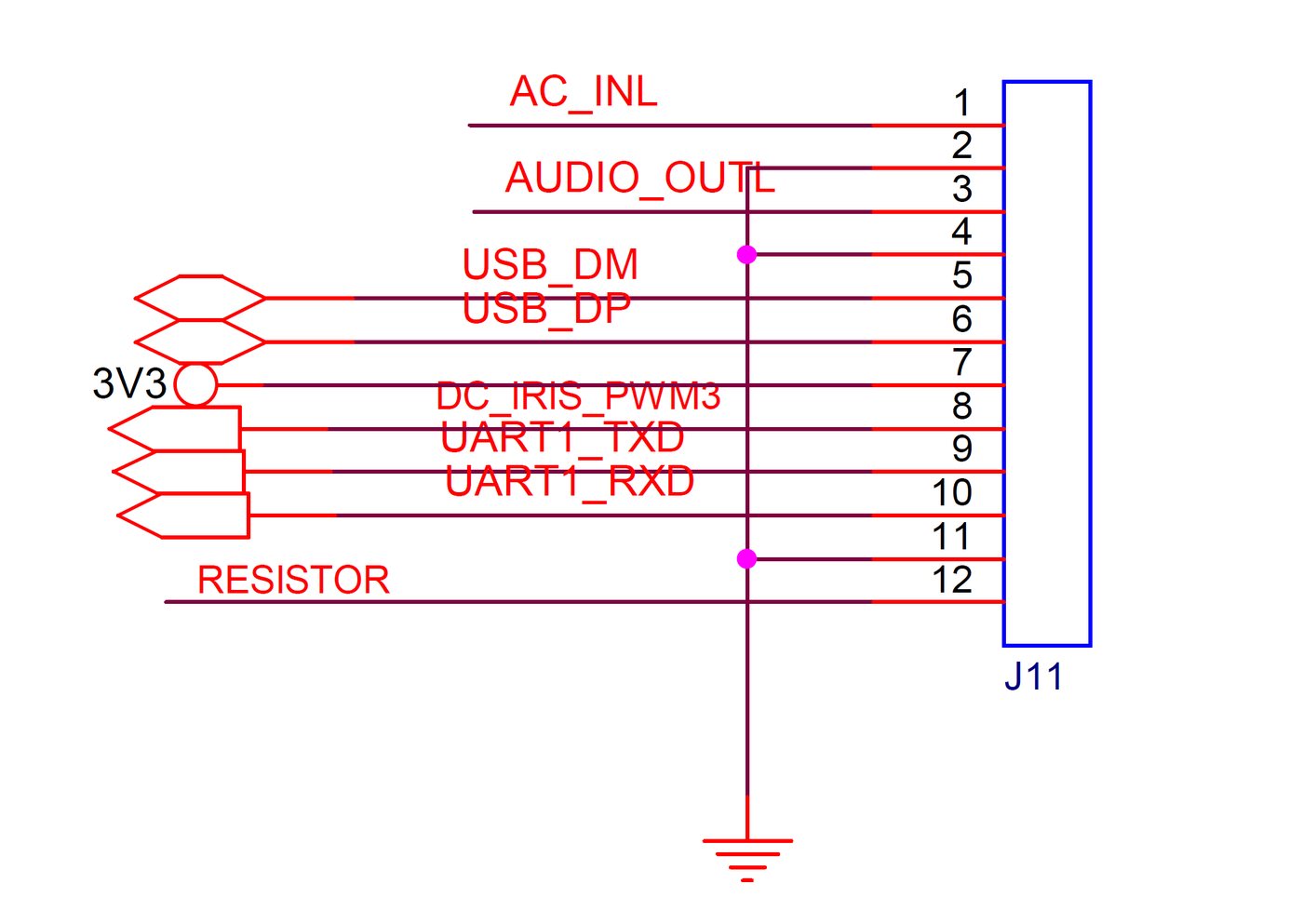
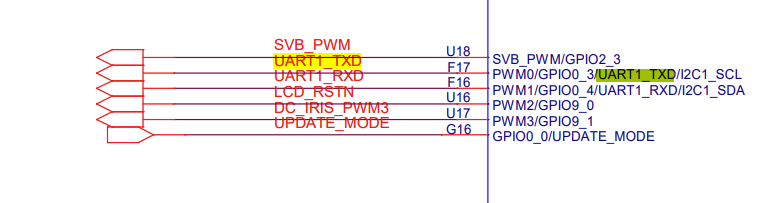
* Analog audio input + analog audio output + TTL serial port 1 + USB interface + GPIO + IRCUT detection(12pin)1
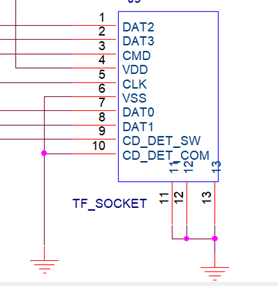
* Micro SD card slot 1
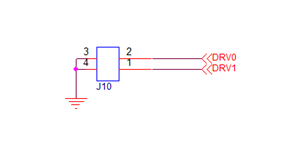
* IRCUT interface*1
VI. Core Board Interface Circuit Diagram
* 12V power supply + 100M network(8pin)1
* Serial port debugging interface(3pin)1
* Analog audio input + analog audio output + TTL serial port 1 + USB interface + GPIO + IRCUT detection(12pin)1
* Micro SD card slot1
* IRCUT interface*1
VII. Device FAQ
| Question | Answer |
|---|---|
| 1、Does it come with flash? | It comes with 16MB of flash |
| 2、What materials are provided? | The full SDK is provided, including encoding and recording materials, Linux code, uboot, etc. |
| 3、Does the development board provide source code for uboot, kernel and rootfs? | Yes, it does |
| 4、Is the ISP already tuned and adapted? Is ISP debugging guidance provided? | The ISP can be adapted by yourself using pqtools. The pqtool tool materials are included. You need to learn ISP debugging yourself; we do not provide guidance |
| 5、Is a hardware reference schematic provided? | The board interface diagram is provided, and the SDK contains reference designs that you can refer to when making your own board |
| 6、Is customized development supported? | Yes, supported |
| 7、Can the ivp and bitrate_auto samples in the HiSilicon samples be run? | Yes |
| 8、Can source code such as GB28181 and ONVIF be provided? | The ONVIF source code is charged separately |
| 9、What is the maximum supported fps? | 30FPS |
| 10、Is WiFi supported? | Not currently. There is a USB interface for expansion, and a WiFi module can be added |
| 11、Are the schematic and PCB provided? | The schematic and PCB are charged separately. The schematic alone costs 3000 |
| 12、Can this HiSilicon solution connect a 4G module? Is there a ready-made driver? Is there a specified 4G module model? | A 4G module can be connected and source code is available. The 4G module uses EC20, which can be purchased together: https://item.taobao.com/item.htm?spm=a21dvs.23580594.0.0.52de3d0dWA5CgG&ft=t&id=687144233515 |
| 13、Is the development environment Ubuntu? | Yes |
| 14、Is the program downloaded to the development board through the serial port? | It is flashed over the network, and a programmer is provided |
| 15、Can the HiSilicon PQTOOL be used? | Yes |
| 16、How many serial ports are there? | 2, one debugging serial port and one TTL serial port |
| 17、What is the difference between ev300 and ev200? | The ev300 is more powerful, with twice the DDR and twice the encoding capability |
| 18、I used dv300 before. Can the program run directly on ev300? | No, but SDK, virtual machine and other development tools are provided |
| 19、Can Ubuntu be installed on this board? | No |
| 20、Can it run HarmonyOS? | No. It can run LiteOS, but no technical support is provided for LiteOS |
| 21、Is there a fast boot solution? | No |
| 22、Is visual recognition supported? | Not supported |
| 23、Can it be used wirelessly and remotely? Is it already developed or not? | No. The customer needs to develop it themselves |