HiSiliconHI3516CV610Development Board38Module
Project: Board Introduction | page_id: 1348
| Model | SC500AI | SC4336P |
|---|---|---|
| Product Series | High-end imaging / ultra starlight AL2 | Traditional series |
| Resolution | 5MP | 4MP |
| Optical Size | 1/2.7" | 1/3" |
| HDR Support | Supported | Not supported |
| Max Frame Rate | 60fps | 30fps |
Configuration Parameters
The module is equipped with an SC500AI camera, 5MP pixels, supporting HDR and wide dynamic range
Better backlight performance
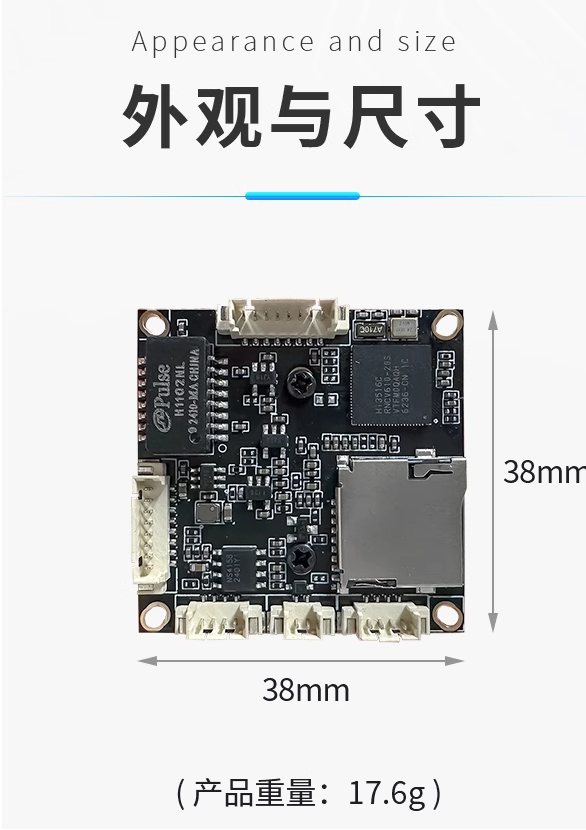
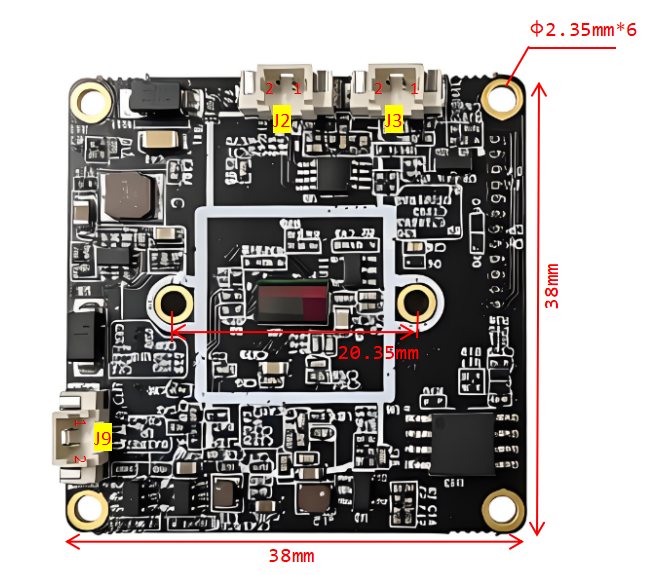
The XCM610 module adopts a standard 38mm single-board design, using the HI3516CV610 chip and the SC500AI camera, with 5MP pixels, HDR support, 128MB DDR and 128MB SPI NAND
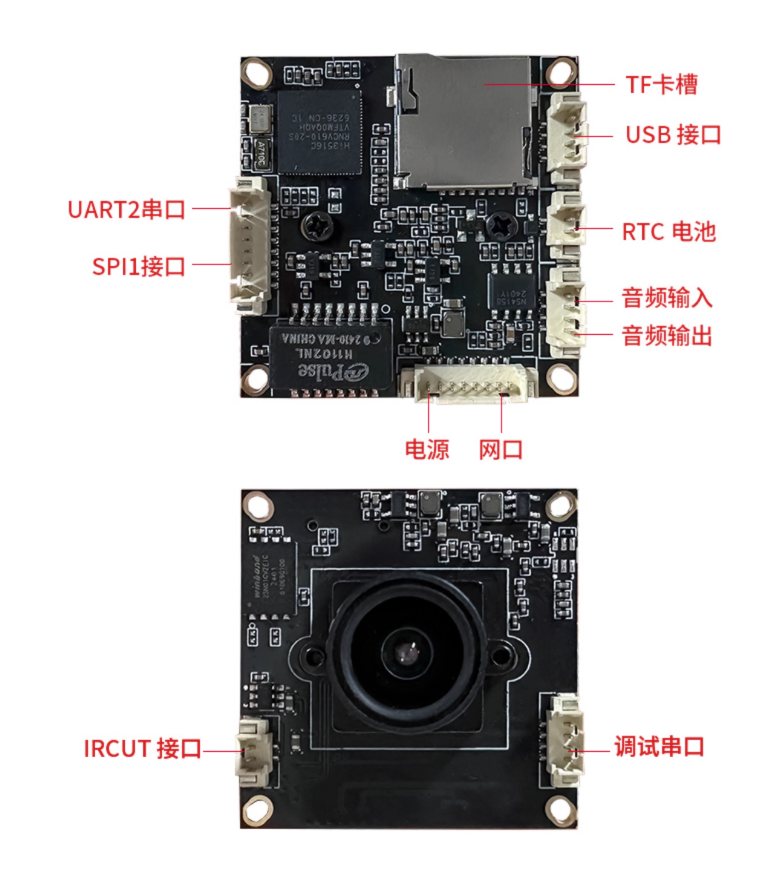
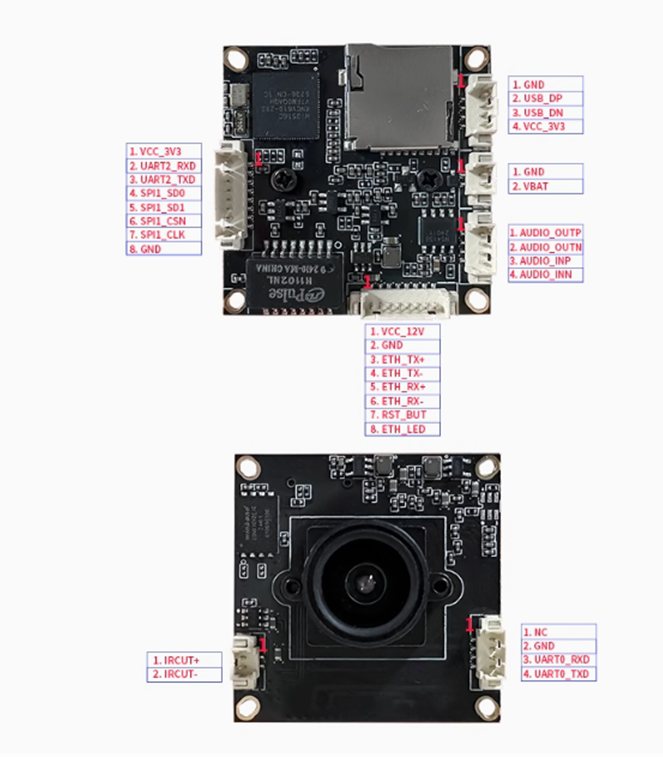
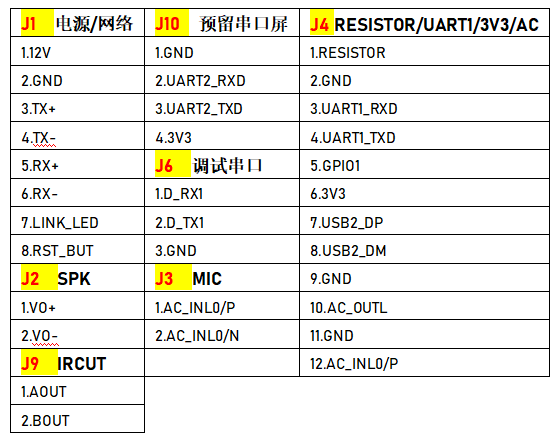
The module provides rich peripherals such as USB HOST/DEVICE, network port, TF card, audio input, audio output (with amplifier), UART, GPIO and IRCUT
Product Introduction
①HI3516CV610
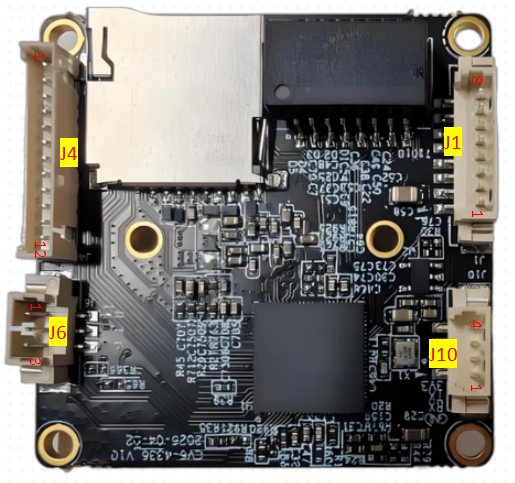
②CV6-4336
Chip Specifications
Features
Processor Core
• Supports ARM Cortex-A7 MP2 • Clock rate 950MHz • Supports 32KB I-Cache, 32KB D-Cache, 128KB L2 cache • Supports Neon and FPU
Intelligent Engine
• Neural network processor NPU −Supports 1Tops computing performance −Supports hundreds of mainstream algorithms in the industry, supporting rapid commercial deployment by customers −Supports Transformer feature acceleration, with a built-in dedicated multimodal large model −Tools support efficient model production and evolution −Built-in algorithms such as face/human/vehicle detection, parcel detection and pet detection • IVE2.5 upgraded operators, supporting motion detection, perimeter protection, tracking, perspective transformation, video diagnosis and various intelligent analysis applications
AI ISP Processing
• Supports basic ISP functions −Supports static and dynamic bad pixel correction −Supports 3A (AE/AWB/AF) functions, with parameters adjustable by users −Supports lens shading correction • Supports high dynamic range −Supports two-frame WDR fusion −Supports Advanced Local Tone Mapping −Supports strong light suppression and backlight compensation • Sharpness and noise reduction −Supports fixed pattern noise (FPN) removal −Motion area effect enhancement algorithm −Supports temporal and spatial noise reduction −Supports multi-level motion detection −Supports regional enhancement −Supports chroma noise removal 2.0 • Color management and contrast enhancement −Supports purple fringe removal 2.0 −Supports key color enhancement −Supports local dynamic contrast enhancement −Supports defog function • PQ Tool 1.2
Video Processing
• Supports image 1/15.5~16x scaling function • Supports lens distortion correction • Supports image Mirror, Flip, 90 degree / 270 degree rotation
Video Encoding
• New generation public security video codec • Supports H.265 Main Profile Level 5 • Supports H.264 BP/MP/HP Level 5.1, with a maximum encoding resolution of 3840×2160 • Supports I/P frames • Supports intelligent encoding 2.0 • Supports privacy encoding • Typical multi-stream encoding performance is as follows: −3200×1800@30fps+1280×720@30fps −3840×2160@20fps+1280×720@20fps • Supports CBR/VBR/ABR/AVBR/CVBR/QVBR/FIXQP/QPMAP and other rate control modes • Maximum output bitrate 80Mbps • Supports pre-encoding OSD overlay for 8 regions • Supports 8 regions of interest (ROI) encoding • Supports JPEG Baseline encoding • JPEG encoding maximum resolution 16384x16384 • JPEG maximum encoding performance: −3200×1800@30fps(YUV420) −3840×2160@20fps(YUV420)
Video Input Interface
• Supports MIPI/LVDS/Sub-LVDS/HiSPi multiple interfaces • Supports 2x2-Lane or 4-Lane combinations, supporting up to 2-channel sensor input • Supports 8/10/12 Bit RGB Bayer • Supports 8/10/12 Bit DVP • Supports BT.601, BT.656, BT.1120 video input interfaces
Audio Interface and Processing
• Built-in Audio codec, supports 16bit dual-channel differential voice input and single-channel single-ended voice output • Supports 1 I2S interface, compatible with multi-channel time division multiplexing transmission mode (TDM) • Supports multi-protocol voice codec • Supports 3A (AEC/ANR/ALC) processing 2.0 • Supports wind noise reduction algorithm • Supports cry detection 2.0, improving the wake-up rate
Security Isolation and Engine
• Supports secure boot • Supports secure boot • Supports TrustZone-based REE/TEE hardware isolation solution • Hardware implementation of AES/RSA/ECC/SHA and other encryption and decryption algorithms • Hardware implementation of SM2/3/4 national cryptographic algorithms
Peripheral Interfaces
• Integrated FE PHY; supports TSO network acceleration • 2 SDIO2.0 interfaces −Supports SDXC card −Supports connecting WiFi module • 1 USB2.0 Host/Device interface • Supports power-on reset (POR) and external input reset • Integrated independent power supply RTC • Integrated multi-channel LSADC • Multiple UART, I²C, SPI, PWM, GPIO interfaces
External Memory Interface
• SDRAM interface Built-in 1Gb DDR3/3L, maximum rate 2133Mbps • SPI Nor Flash interface −Supports 1, 2, 4-wire modes −Maximum capacity supports 32MB • SPI Nand Flash interface −Supports 1, 2, 4-wire modes −Maximum capacity supports 512MB • eMMC4.5 interface, 4bit data width • Can choose to boot from eMMC, SPI Nor/SPI Nand Flash
SDK
• Supports Linux5.10 SDK package • Supports OpenHarmony 4.1
Chip Physical Specifications
• Power consumption Typical power consumption: TBD • Operating voltage −Typical core voltage 0.9V −IO voltage 1.8/3.3V −DDR3/3L interface voltages are 1.5V/1.35V respectively • Operating temperature: -20°C~70°C • Package −RoHS, QFN